

Why Confidential?
According to KPMG, 63% of enterprises say that confidentiality and data privacy are their top risk to AI adoption (1). In regulated sectors, this figure increases to 76%. Yet, when it comes to solutions which address these concerns, the market has yet to answer. This leaves a critical mass of companies unserved and unable to adopt AI in their workflows. They need Confidential AI.Where CyborgDB Fits in Your Stack
Think of CyborgDB as a dedicated vector layer that sits alongside your application: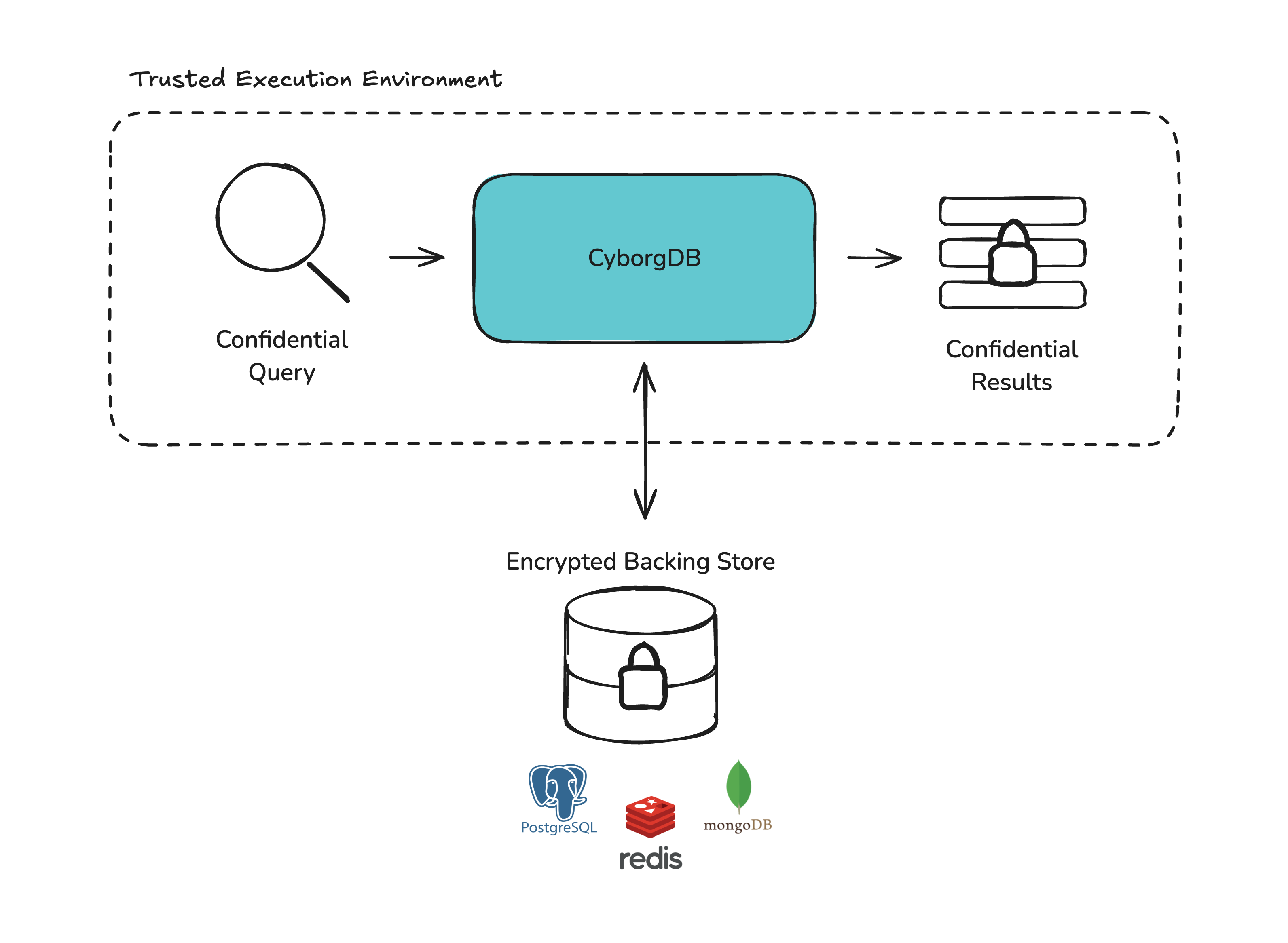
- No data leaves your infrastructure - Run it in your VPC or on-prem
- Familiar development patterns - A vector API that slots into existing AI pipelines
- Minimal operational surface - Local disk by default; no separate database to run
- Gradual adoption possible - Start with vector search, expand as needed
The Vector Search Problem
Vector Search powers the most popular AI applications - RAG, RecSys, Semantic Search, etc. However, traditional vector databases have a fundamental security flaw: they use (and often store) vector embeddings in plaintext to enable fast similarity search. This creates a massive attack surface. Your sensitive data - converted to embeddings that still contain semantic meaning - sits unprotected in your database. For enterprise AI applications, this is unacceptable. CyborgDB solves this by enabling Approximate Nearest-Neighbor (ANN) search directly over encrypted vectors. Your embeddings are never stored in plaintext, and during search only the candidates being scored are decrypted.How CyborgDB Works
CyborgDB uses cryptographic hashing and symmetric encryption to enable vector search over encrypted data: The Process:- Your app sends vectors → CyborgDB encrypts them using your private key
- Encrypted vectors stored → Your database stores only encrypted data, never plaintext
- Search tokens derived → Your key derives search tokens for the relevant clusters
- Search over encrypted space → ANN search happens on encrypted vectors
- Results returned → Matching vectors and metadata
Why Developers Choose CyborgDB
🔄 Works with Your Existing StackNo need to rewrite applications. CyborgDB exposes a familiar vector API that drops into the AI pipelines and frameworks you already use. 🔒 True End-to-End Encryption
Vector embeddings stay encrypted throughout their entire lifecycle - at rest, in transit, and during search operations, where only the candidates being scored are decrypted. ⚡ Production-Ready Performance
GPU-accelerated indexing and training with CUDA support. Optimized algorithms deliver fast results without compromising security. 🛠️ Developer-Friendly APIs
Familiar programming interfaces and extensive framework integrations (LangChain, etc.) make adoption seamless within existing AI workflows. 📈 Flexible Deployment
Deploy as embedded libraries for maximum control, or as a service for easier scaling. Choose what works best for your team and infrastructure.
Next Steps
Start Building
Get hands-on in minutesChoose your deployment path and build your first confidential vector search application
Choose Your Deployment
Embedded vs ServiceUnderstand the trade-offs between embedded libraries and service deployment
Backing Stores
Disk, S3Learn where CyborgDB persists your encrypted index, and how to pick per environment